looking to buy a home?
Submit this Form and Benefit from our 25 Years' Experience & Strong Local Network.The Costa del Sol is entering its biggest infrastructure investment period in decades. Between now and 2031, major projects such as a €1.5 billion Malaga airport expansion, a new legal planning framework for Marbella, two marina upgrades, and new residential land in northern Marbella will reshape the coastline. None of these projects exists in isolation. Together, they tell us about the changes you will see in Costa del Sol in the coming years.
Here’s a list of the five developments that will drive the change, what’s confirmed so far, and what it could mean for buyers and investors over the next few years.
1. Málaga Airport Expansion
Málaga-Costa del Sol Airport closed 2025 with 26.7 million passengers, its best year on record, and 2026 is tracking even higher, with 13.22 million passengers in the first half, up 6.7% on the same period in 2025. With current capacity capped at around 30 million, Spain’s airport operator Aena has moved from planning to funding.
In September 2026, the Spanish government approved €830 million as part of Aena’s wider DORA III investment programme (2027–2031), which allocates roughly €1.5 billion in total to Málaga as one of the network’s key projects. The goal: raise annual capacity to 36 million passengers.
The scale of the physical changes is significant:
- Terminal space nearly doubles, from 80,000 m² to 140,000 m²
- The former Terminal 1 and piers B and C will be demolished and rebuilt
- Retail space and VIP lounge space will be increased
- Road access and parking facilities will also be expanded
The design phase is underway through 2026, with construction expected to start from 2029 and full completion by 2031. Most importantly, the airport will stay operational throughout.
Why it matters for Costa del Sol
Historically, airport capacity has been linked to second-home and holiday-let demand along the Costa del Sol. A near-doubling of non-Schengen handling capacity specifically targets the UK international buyer base, and Gulf and other non-EU markets that drive much of Marbella and Estepona’s luxury property market.
2. Marbella’s New PGOM
Much of what’s described below new residential land, marina expansion, infrastructure upgrades depends on a single document: Marbella’s new General Municipal Development Plan (PGOM), approved by the municipal council on 18 September 2026.
This replaces the city’s outdated 1986 planning framework and makes Marbella the first municipality in Andalusia with a plan fully adapted to the regional LISTA law. The headline figures:
- Urban land rises from roughly 40 million m² to 53 million m², a confirmed increase of about 13 million m²
- 64 million m² remains classified as rural, though 30 million m² of that is designated as potentially “transformable to urban” in future, subject to planning, infrastructure, and environmental review
- On urban land, it reserves 20% of new residential buildable area for affordable housing
- The plan addresses roughly 18,000 homes left in legal limbo by decades of planning uncertainty, offering greater legal certainty to owners
One step remains: the POU (Plan de Ordenación Urbana), the detailed zoning document that will set street-level rules, building heights, neighbourhood layouts, and technical standards, is still being processed.
Why it matters
This is the legal foundation for every future development in the area. Without the PGOM, future projects would not have any valid framework for the residential and commercial development that follows. For buyers, the housing quotas also mean a different supply mix is coming: not just luxury villas, but a mandated number of affordable and mid-market housing alongside them.
3. Upgradation of La Bajadilla and Puerto Banús Marinas
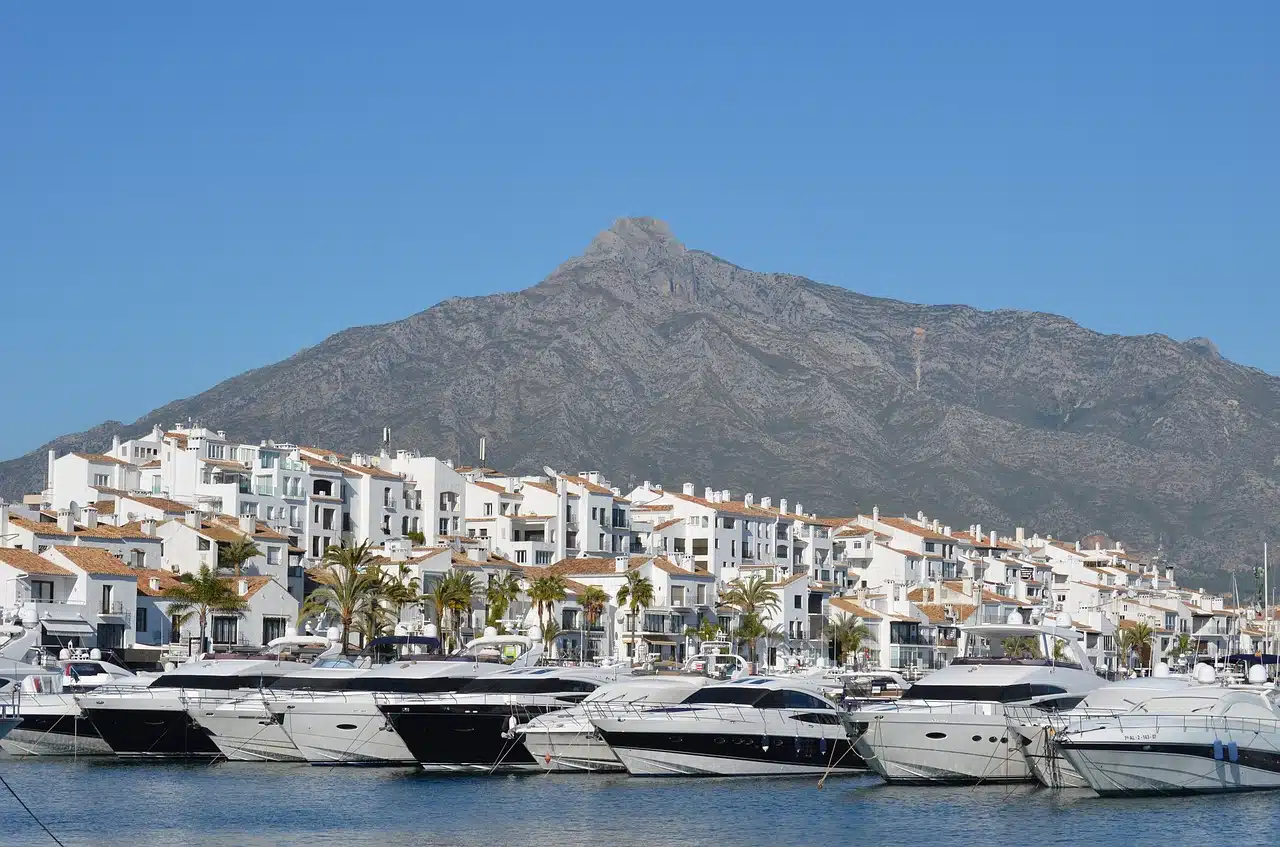
Marbella’s two marinas are set for upgradation, but through very different routes and for different markets.
Following a 15-year delay, La Bajadilla, the eastern fishing port in Marbella, has successfully been granted a 40-year concession, attracting more than €200 million in private funding. The project will:
- Nearly triple capacity, from 268 to approximately 750 berths
- Accommodate yachts up to 70 metres
- Add commercial space and around 1,000 parking spaces
- Move beach sand onto Venus, La Bajadilla, El Cable and El Faro as part of coastal works
The new concessionaire takes over existing facilities from 1 January 2027, with the construction set to start in the same year.
Puerto Banús, Marbella’s long-established luxury marina, is taking a different path. Rather than expanding its physical footprint, its owners, the Vidiella family, who have run the concession since 1983, are modernising the marina with replacement of eight fixed pontoons with floating decks by late 2026. This €9 million modernisation plan will also include the conversion of parking spaces into new restaurant terraces. The Vidiella family is also exploring bringing in a financial partner to fund expansion of the “Puerto Banús” brand.
Why it matters
These are complementary, not competing, projects. La Bajadilla fills a real capacity gap on the eastern side of town and opens Marbella to a genuinely new tier of superyacht traffic, while Puerto Banús focuses on brand expansion rather than basin size. For property buyers, La Bajadilla’s growth is likely to be the more consequential story for Marbella’s old town and fishing-quarter area, which has historically lagged the glamour (and prices) of the Golden Mile and Puerto Banús side of the city.
4. Northern Marbella’s Residential Expansion
A new residential development is reportedly moving forward in northern Marbella, near La Cañada and Trapiche del Prado, close to the AP-7. Early reporting puts the project at around 156 homes across more than 105,000 m², with the Marbella City Council having accepted the urbanisation project for processing.
This is an earlier-stage project as there is no update on the start date for construction.
Why it matters
It signals that growth isn’t confined to the coastline; inland Marbella, closer to the AP-7 corridor, is part of the city’s development in the next phase.
Also, any new construction in this location must adhere to the PGOM’s affordable-housing requirements, which serve as a real-world case study of how housing quotas will be implemented on the ground.
5. Other Infrastructure Projects
The PGOM isn’t just a housing document; it sets out supporting infrastructure for all of the above. Confirmed provisions include:
- Upgrades to the A-7, plus the Ronda and Istan roads
- Space formally reserved for potential future rail connectivity in Marbella
- New cycling networks and expanded parking infrastructure
None of this is as advanced as the airport or marina projects; much of it is framework-level provision rather than funded construction, but it matters because it shows the direction of planning for the next decade, including the rail reservation, which would be a genuinely significant long-term shift if it materialises.
What This Means for Buyers and Investors
Looked at together, these projects point to clear patterns. International access is being prioritised. The airport’s non-Schengen expansion is a response to the Costa del Sol’s reliance on UK and other non-EU buyers and visitors. Expect continued demand from these markets as the 2027–2031 build-out progresses.
Marbella now has legal certainty it didn’t have for 40 years. The PGOM resolves a risk that deterred some institutional investment and complicated permitting. That certainty, more than any single project, is likely to be the most consequential change for serious long-term investors.
The airport won’t be finished until 2031. La Bajadilla won’t be expanded until around 2030. The PGOM’s document, the POU, is still being drafted. None of this is a short-term story; it will be a multi-year process that will bring changes to the coast.
Conclusion
The airport expansion secures the region’s connectivity for the next generation of international buyers. The PGOM gives Marbella the legal clarity it has lacked since 1986. The marina projects open the coast to a new tier of superyacht and luxury tourism. And the infrastructure projects, modest as they are for now, hint at a coast that’s planning for growth well beyond 2031.
The next three to four years will reward the early movers and people who understand which projects are underway and which neighbourhoods are set to benefit the most from these projects.